
110V vs 220V: What Travelers Need to Know
Electrical systems around the world operate at different voltages. The United States and Canada use 120 volts, Mexico uses 127 volts, and Japan uses 100 volts, while most of Europe, Asia, Africa, and Australia operate on 220–240 volts.
A plug adapter, also spelled plug adaptor, only changes the shape of the plug so it fits into a foreign outlet. It does not convert electrical voltage. Plugging a device designed only for 120V into a 220–240V outlet using only a plug adapter can permanently damage the device.
110V vs 220V Quick Comparison
| Feature | 100–127V Systems | 220–240V Systems |
|---|---|---|
| Common Regions | United States, Canada, Mexico, Japan, and parts of the Caribbean and Central America | Europe, UK, Australia, most of Asia and Africa |
| Typical Plug Types | Type A, Type B | Types C, E, F, G, I and others |
| Adapter / Adaptor Needed When Traveling | Depends on the destination’s plug type; voltage does not determine whether an adapter is needed. | Depends on the destination’s plug type; voltage does not determine whether an adapter is needed. |
| Converter Needed | Only for single-voltage devices rated for a different voltage | Only for single-voltage devices rated for a different voltage |
What Voltage Means
Voltage measures the electrical pressure supplied by a power outlet. Devices are designed to operate within specific voltage ranges. Supplying higher voltage than the device expects can cause overheating, failure, or permanent damage.
Plug shape and electrical voltage are separate issues. A country may use a different wall outlet, a different voltage, or both.
100–127V Countries
Lower-voltage electrical systems include 100V in Japan, 120V in the United States and Canada, 127V in Mexico, and voltages within the 100–127V range in parts of the Caribbean and Central America.
For a complete listing of national electrical standards, see our voltage by country reference.
220–240V Countries
Most countries worldwide operate on higher-voltage systems between 220 and 240 volts, including most of Europe, the United Kingdom, Australia, Africa, and much of Asia.
You can identify the outlet types used in your destination by browsing plug types by country.
When You Only Need a Plug Adapter or Adaptor
Most current phone, tablet, camera, and laptop chargers accept international voltage. Check the printed input rating on the charger or power supply for:
Input: 100–240V 50/60Hz
Devices with this rating require only the correct plug adapter or travel adaptor for the outlet shape. This applies to most current laptop chargers, phone chargers, tablet chargers, camera chargers, and many battery chargers.
If the label says 100–240V, the device is designed to handle electrical systems throughout that range, including 100V, 120V, 127V, and 220–240V systems. You still need the correct plug adapter or adaptor for the outlet shape used in your destination.
When You Need a Voltage Converter
Some appliances are designed for only one voltage. High-wattage heating appliances are the most common source of voltage trouble for travelers. A travel voltage converter changes voltage; it does not convert 50Hz power to 60Hz or 60Hz power to 50Hz. Check both the voltage and frequency rating for motors, clocks, and other frequency-sensitive appliances.
Dual-Voltage Travel Appliances
Hair dryers, curling irons, and straighteners are commonly single-voltage appliances. For overseas travel, use a dual-voltage appliance rather than relying on a converter.
 Shop Dual-Voltage Travel Appliances →
Quick Travel Voltage Checklist
- Check the outlet type used in your destination.
- Check the voltage printed on your device or charger.
- Look for Input: 100–240V 50/60Hz on chargers and power supplies.
- Use a plug adapter or travel adaptor when only the plug shape is different.
- Use a voltage converter only for compatible single-voltage devices.
- Use dual-voltage travel appliances for hair dryers, curling irons, and straighteners.
110V vs 220V Travel FAQ
Can I plug a 110V device into a 220V outlet?
Not unless the device is rated for 220V or 100–240V input. A 110V-only device plugged into a 220–240V outlet can overheat, fail, or be permanently damaged.
Does a plug adapter or adaptor convert voltage?
No. A plug adapter, also called a plug adaptor, only changes the shape of the plug so it fits the wall outlet. It does not convert 220V power to 110V, or 110V power to 220V.
How do I know if my charger is dual voltage?
Check the label on the charger or power supply. If it says Input: 100–240V 50/60Hz, it is designed for international voltage and requires only the correct plug adapter or travel adaptor.
Do phones and laptops need voltage converters?
Most current phone chargers, tablet chargers, camera chargers, and laptop power supplies accept 100–240V input. Check the printed input rating before plugging them in overseas.
Do hair dryers and curling irons need voltage converters?
Hair dryers, curling irons, and hair straighteners are commonly single-voltage appliances. For overseas travel, use a dual-voltage appliance rather than relying on a converter.
Adapter may also be spelled adaptor. Voltage converter may also be spelled voltage convertor, but converter is the more common spelling for travel power products.
Before You Travel
Before departure, confirm both the outlet type and voltage used at your destination. Use our voltage by country guide, plug type reference, and country plug guides to identify the correct equipment for your trip.
Travel WiFi for Longer Trips
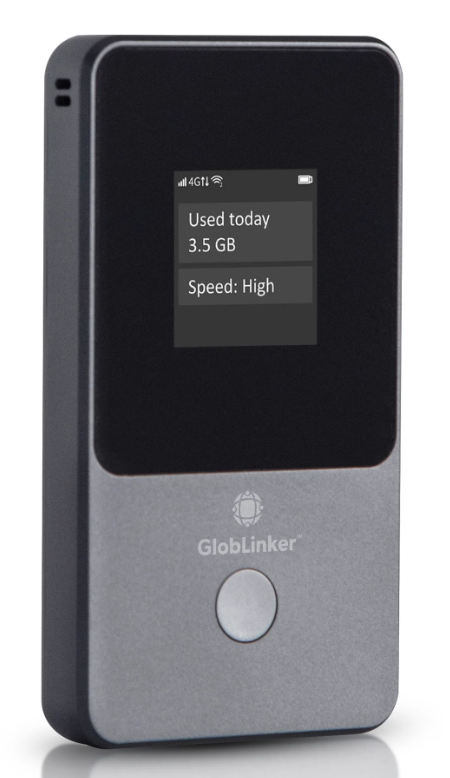
Globlinker automatically connects to the strongest available local mobile network. Use it in the U.S. and 130+ countries without a SIM, contract, subscription, or roaming fees.